The Home Gardens (Blog) is reader-supported. When you buy through links on this page, we may earn an affiliate commission at no additional cost to you.
If your dog is peeing on your bed, there is no denying that it feels personal, and it’s completely understandable to feel frustrated and overwhelmed. Dog urine can permanently damage a mattress, and if you don’t clean the area thoroughly, the lingering scent will draw your dog back to the same spot again and again.
Your bed is soft, absorbent, and saturated with your scent. That makes it one of the most appealing places in the house for your dog — and unfortunately, one of the most appealing places to relieve themselves when something is wrong. Many people assume their dog is being dominant or spiteful, but the truth is more nuanced. Bed-wetting in dogs is almost always a signal that something needs attention; it could be a health issue, a training gap, or an emotional trigger.
The first step is identifying the underlying cause. Your vet is the right starting point. Once you rule out medical problems, you can shift focus to behavioural solutions.
Common Medical Causes Leading to Accidental Elimination
Urinary Tract and Kidney Problems
Urinary tract infections (UTIs) are one of the most common reasons dogs have accidents indoors. The infection causes discomfort and a persistent urge to urinate, making it genuinely difficult, sometimes impossible, for your dog to hold on until they’re outside. Your vet will likely request a urine sample to run a urinalysis, and if a UTI is confirmed, a course of antibiotics will typically clear it up.
Beyond UTIs, a range of other urinary conditions can affect bladder control, including:
- Cystitis (bladder inflammation)
- Crystals in the urine or bladder stones
- Structural abnormalities of the urinary tract
- Kidney disease
- Tumors
Most of these conditions are manageable with medication, dietary changes, or supplements. Bladder stones may require surgery in more serious cases. Systemic diseases like diabetes and Cushing’s disease can also affect urinary function, so these are worth ruling out as well.
Incontinence
Dogs with urinary incontinence leak urine involuntarily, often without any awareness that it’s happening. In some dogs this only occurs during sleep; in others, urine may dribble even while they’re awake and moving around.
Incontinence is most common in senior dogs as bladder muscle tone decreases with age, but it can also affect younger dogs. Hormone-responsive incontinence is particularly common in spayed female dogs and occurs occasionally in males as well. The reassuring news is that medications are available and often very effective.
Emotional Drivers Leading to Accidental Elimination
Incomplete House Training
Not every dog that appears house-trained truly is. Some dogs learn to avoid going indoors in most situations but prefer certain soft or absorbent surfaces, and your bed fits that description perfectly. If you suspect house training is the root of the problem, a return to fundamentals is in order.
Excitement, Fear, Stress, and Anxiety
Excitement urination is common in younger dogs and puppies. When they’re overstimulated or placed in a submissive position, they may dribble urine involuntarily. Most dogs grow out of this as they mature, but some will need structured training if the behaviour persists.
Fear, stress, and anxiety are also significant triggers. A dog that is frightened by loud noises, an unfamiliar visitor, or a change in the household may urinate without warning. Your bed is a place of comfort and security for your dog, so it’s often where they retreat when they’re scared, making it a common site for these accidents.
Environmental changes that may be causing stress include:
- A house move or major renovation
- The arrival of a new baby, partner, or pet
- Changes in your work schedule or daily routine
- Loud events like thunderstorms or fireworks
Underlying medical conditions can also cause chronic low-level stress, which is another reason a vet visit should always come first.
Territorial Marking
Some dogs use urine to mark territory, and your bed strongly carries your scent, which makes it a natural target. Marking typically involves smaller amounts of urine deposited deliberately, often near the edges of the bed rather than the centre.
Marking behaviour is more common in intact (unaltered) dogs, where hormonal drives significantly amplify the urge to leave a scent. Spaying and neutering reduce marking in most dogs by removing the hormonal fuel behind it. In addition to neutering, consistent training and behaviour modification can bring the behaviour under control.
Senior Dogs – Canine Cognitive Dysfunction
If you have an older dog, you should be aware of canine cognitive dysfunction (CCD), sometimes called doggy dementia, as a possible cause of sudden house-training regression. CCD is a progressive neurological condition that closely resembles Alzheimer’s disease in humans, and it is more prevalent than many people realise. According to PetMD, studies estimate that 28% of dogs aged 11–12 are affected, rising to 68% of dogs aged 15- 16.
Dogs with CCD may forget where they are supposed to go, fail to signal that they need to go outside, or become disoriented enough that they simply can’t make it in time. If your senior dog is also showing signs of confusion, disrupted sleep, changes in social behaviour, or increased anxiety, discuss the possibility of CCD with your vet.
While there is no cure, early intervention, including specific diets, supplements, and in some cases medication, can slow progression and improve quality of life.
How to Stop Your Dog From Peeing on the Bed
Start With Your Vet
Before attempting any behavioural intervention, book a vet appointment. Your vet will perform a physical examination, collect a urine sample, and may recommend additional blood work or imaging depending on what they find. Treatment will depend entirely on the diagnosis. A dog with a UTI needs antibiotics; a dog with incontinence may need hormone therapy or medication; a dog with CCD requires a different approach altogether.
Assess and Adjust the Environment
Look honestly at your dog’s environment. Have any recent changes been causing stress or anxiety? Dogs are highly sensitive to shifts in household routine, and an anxious dog cannot learn effectively. Address the source of stress first, and if the anxiety is significant, ask your vet about anti-anxiety supplements or medication to use alongside training.
Build Good Habits Through Consistent Training
If you can, restrict access to the bed whenever you’re not home. Keep the bedroom door closed, or use a baby gate to block entry. We live in a studio apartment, making things a little interesting. Crate training during your absence can help enormously in this situation; dogs instinctively avoid soiling their sleeping area, which encourages bladder control.
When you are home, take your dog outside frequently and on a predictable schedule:
- First thing in the morning
- After every meal
- After naps and play sessions
- Before bed
Only allow your dog on the bed when you are on it and can supervise. Reward outdoor urination generously with treats and praise every time; this builds a strong, positive association with going in the right place. Do not punish accidents; punishment after the fact increases anxiety and makes the underlying problem worse, not better.
If you catch your dog in the act, interrupt calmly. A firm “no” or “uh-oh” is enough, then immediately take them outside to finish.
Seek Professional Help When Needed
Training to correct inappropriate urination takes time, and it can become frustrating. If you’re not seeing progress after several weeks of consistent effort, a certified dog trainer or veterinary behaviourist can offer structured guidance tailored to your dog’s specific situation.
Clean Dog Pee Immediately
Thorough cleaning is imperative. If any trace of urine remains in the mattress, your dog’s nose will find it, and that lingering scent tells them this is an acceptable place to go.
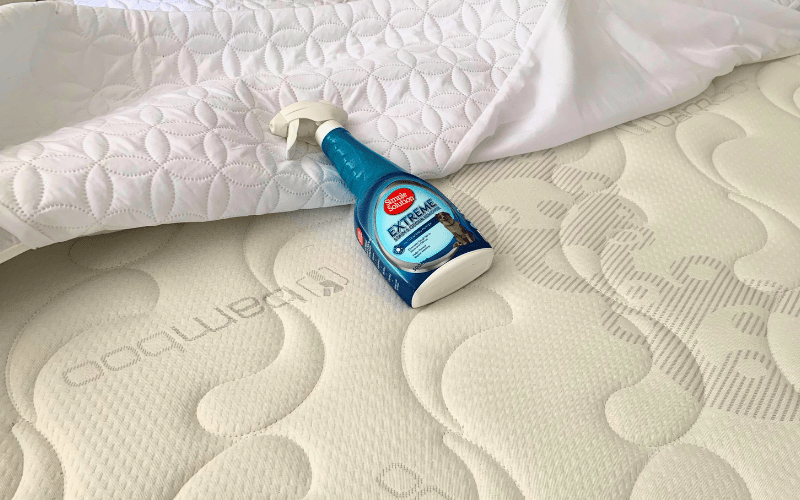
Standard household detergents are not sufficient. They may mask the odour for you, but they cannot break down the uric acid crystals in dog urine that dogs can still detect. You need an enzymatic cleaner. A product that uses beneficial bacteria to break down the organic compounds in urine at a molecular level, eliminating the scent rather than covering it up. Well-regarded options include Nature’s Miracle and Rocco & Roxie Supply Co.
Once you’ve deep-cleaned your mattress, invest in a waterproof mattress protector. It creates a barrier that prevents future accidents from penetrating the mattress and makes cleanup far easier if another accident occurs during retraining.
FAQs
Start with your veterinarian to rule out medical causes — UTIs, kidney disease, incontinence, diabetes, and canine cognitive dysfunction are all possibilities. Once health issues are excluded, look at any recent changes to your dog’s environment or routine that might be causing stress or anxiety.
Yes, in most cases. Restrict access to the bed when you’re not supervising, take your dog outside frequently, and reward outdoor urination consistently. If training alone isn’t working, consult a professional trainer or behaviourist.
Yes — UTIs, cystitis, bladder stones, kidney disease, diabetes, Cushing’s disease, hormonal incontinence, and canine cognitive dysfunction can all lead to inappropriate urination. A vet assessment is the necessary first step.
Book a vet appointment. Age-related incontinence, kidney disease, diabetes, and canine cognitive dysfunction are all common in older dogs and all treatable to varying degrees. In the meantime, a waterproof mattress protector and more frequent potty breaks will help manage the situation.
Dog urine contains uric acid crystals that standard detergents can’t fully neutralise. Even if you can’t smell anything, your dog still can. An enzymatic cleaner is the only way to fully break down the scent and stop your dog from returning to the same spot.